


What Is Ethereum?
Ethereum is a decentralized, open-source blockchain platform that introduced smart contracts — self-executing programs that run automatically when predefined conditions are met. While Bitcoin was designed primarily as digital money, Ethereum was built as a programmable blockchain that developers can use to create decentralized applications (dApps), tokens, and entire financial systems.
Ethereum was proposed in 2013 by Vitalik Buterin and launched on July 30, 2015. Its native cryptocurrency, Ether (ETH), is the second-largest cryptocurrency by market
capitalization and is used to pay transaction fees (gas), stake for network security, and serve as a store of value.
How Does Ethereum Work?
Ethereum operates as a decentralized computer that runs code submitted by anyone, verified by thousands of nodes worldwide.
A developer deploys a smart contract — a piece of code with rules and logic — to the Ethereum blockchain.
A user interacts with the smart contract by sending a transaction (e.g., swapping tokens, lending assets, minting an NFT).
The transaction is broadcast to the network and picked up by validators.
Validators verify the transaction and execute the smart contract code using the Ethereum Virtual Machine (EVM).
Once consensus is reached, the transaction is included in a new block.
The block is finalized, the state of the blockchain updates, and the transaction becomes permanent.
Every operation on Ethereum costs gas — a fee paid in ETH that compensates validators for the computational work required to process the transaction.
Ethereum's Transition to Proof of Stake
In September 2022, Ethereum completed "The Merge" — a historic upgrade that changed its consensus mechanism from Proof of Work (mining) to Proof of Stake (staking).
| Aspect | Before The Merge (PoW) | After The Merge (PoS) |
|---|---|---|
| Consensus | Miners solve puzzles | Validators stake ETH |
| Energy usage | ~112 TWh/year | Reduced by ~99.95% |
| Hardware required | Specialized mining rigs (GPUs/ASICs) | Standard computer + 32 ETH stake |
| Block time | ~13 seconds | ~12 seconds |
| New ETH issuance | ~13,000 ETH/day | ~1,700 ETH/day |
| Security model | Cost of electricity | Cost of staked ETH (slashing risk) |
This made Ethereum one of the most energy-efficient major blockchains and introduced ETH staking as a way for holders to earn rewards while securing the network.
Key Features of Ethereum
Smart Contracts
Smart contracts are programs stored on the blockchain that execute automatically when conditions are met. They enable trustless agreements — no lawyer, bank, or middleman needed. Once deployed, a smart contract cannot be altered, ensuring that the rules are enforced exactly as coded.
Ethereum Virtual Machine (EVM)
The EVM is the runtime environment that executes smart contract code on every node in the network. It ensures that all nodes reach the same result for every transaction. The EVM
has become an industry standard — many other blockchains (BNB Chain, Polygon, Avalanche, Arbitrum) are "EVM-compatible," meaning they can run the same smart contracts.
Gas Fees
Every operation on Ethereum requires gas, measured in gwei (0.000000001 ETH). Gas fees fluctuate based on network demand. When the network is busy, fees rise. When activity is
low, fees drop. Since the EIP-1559 upgrade, a portion of every gas fee is burned (permanently removed from circulation), making ETH potentially deflationary during high-activity
periods.
ERC Token Standards
Ethereum introduced token standards that allow anyone to create digital assets on the network:
| Standard | Purpose | Examples |
|---|---|---|
| **ERC-20** | Fungible tokens (currencies, utility tokens) | USDT, LINK, UNI, AAVE |
| **ERC-721** | Non-fungible tokens (unique digital assets) | CryptoPunks, Bored Apes |
| **ERC-1155** | Multi-token standard (fungible + non-fungible) | Gaming items, mixed collections |
Ethereum vs Bitcoin
| Feature | Ethereum (ETH) | Bitcoin (BTC) |
|---|---|---|
| Primary purpose | Programmable blockchain for dApps | Digital money and store of value |
| Smart contracts | Full support (Solidity, Vyper) | Limited (Bitcoin Script) |
| Consensus | Proof of Stake | Proof of Work |
| Supply cap | No hard cap (with burn mechanism) | 21 million BTC (fixed) |
| Block time | ~12 seconds | ~10 minutes |
| Transaction throughput | ~15-30 TPS (L1), 1000s+ (with L2s) | ~7 TPS |
| Ecosystem | DeFi, NFTs, DAOs, gaming, L2s | Payments, store of value, Lightning Network |
What Is Built on Ethereum?
Ethereum powers the majority of the decentralized ecosystem:
DeFi (Decentralized Finance) — Lending (Aave), trading (Uniswap), stablecoins (DAI), and yield protocols
NFTs — Digital art, collectibles, and ownership records
DAOs (Decentralized Autonomous Organizations) — Community-governed organizations with on-chain voting
Layer 2 Networks — Scaling solutions like Arbitrum, Optimism, Base, and zkSync that process transactions faster and cheaper while inheriting Ethereum's security
Stablecoins — USDT, USDC, and DAI are primarily issued on Ethereum
Gaming and Metaverse — On-chain games and virtual worlds with player-owned assets
Ethereum's Roadmap
Ethereum development continues through several planned upgrades:
Dencun (completed 2024) — Introduced proto-danksharding (EIP-4844) to dramatically reduce Layer 2 fees
Pectra (2025) — Account abstraction improvements and validator optimizations
Verkle Trees (planned) — Reduces node storage requirements, making it easier to run a validator
Full Danksharding (planned) — Massively increases data availability for Layer 2 networks
The long-term goal is to make Ethereum capable of processing 100,000+ transactions per second through its Layer 2 ecosystem while keeping the base layer maximally decentralized
and secure.
Ethereum and Trust Wallet
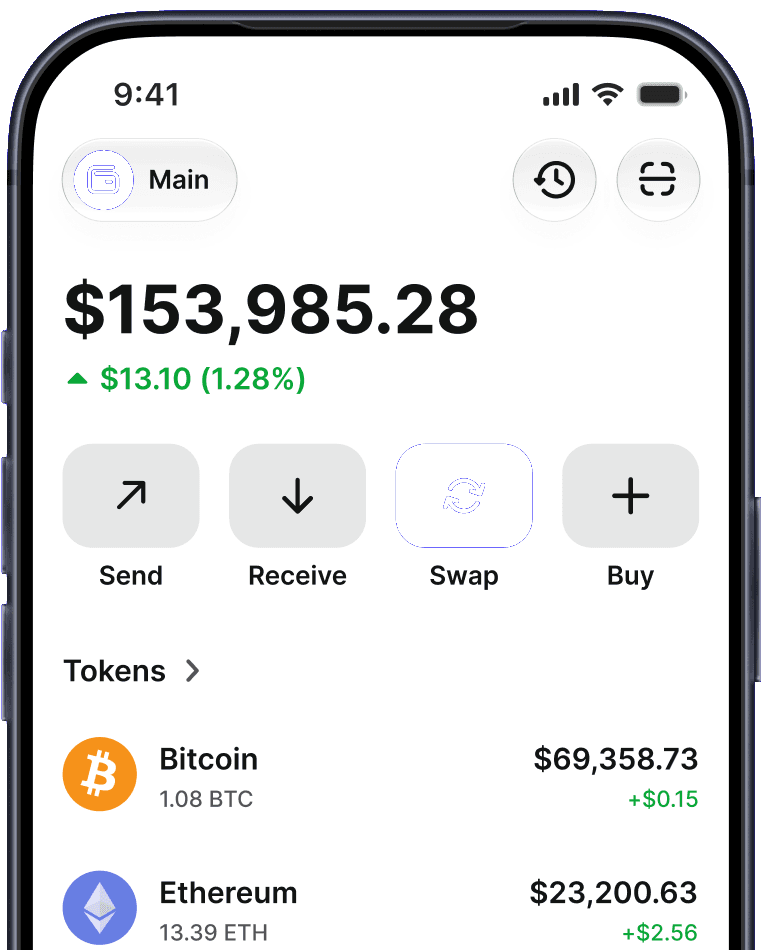
Trust Wallet gives you full access to the Ethereum ecosystem. You can store and manage ETH, send and receive tokens, interact with DeFi protocols, stake ETH to earn rewards, swap ERC-20 tokens, and connect to Ethereum dApps directly through the built-in dApp browser — all while keeping complete control of your private keys.