

ether.fi has been generating widespread interest in the crypto space. But what exactly is ether.fi, and how does it work? In this article, we’ll explore its core principles, features, and how the eETH, weTH and ETHFI tokens work.
Before we get started, remember that you can easily manage Ethereum (ETH), eETH and ETHFI using Trust Wallet.
Ether.fi Overview
ether.fi is a crypto neobank where users can save, grow, and spend their crypto through one connected experience. Common use cases include buying tokens, earning on crypto through vaults, sending money globally through fiat on- and off-ramps, and purchasing everyday goods through a credit card.
Behind that experience is a non-custodial infrastructure that keeps users in control of their assets. Rather than separating investments from everyday finances, ether.fi makes it possible to put assets to work, access liquidity against them, and use them in daily life from the same platform.
Ether.fi Key Features
ether.fi began with Ethereum staking infrastructure and has expanded into a full crypto-neobank product suite. One of ether.fi key features is its liquid staking functionality. Instead of locking up ETH for extended periods, users receive liquid tokens, such as eETH (ether.fi Staked ETH), in return for their staked ETH. These tokens represent a staked ETH position and can be transferred or used in supported decentralized finance (DeFi) applications, providing greater flexibility and liquidity.
ether.fi also provides other onchain features, including automated strategies through Liquid, supported payment functionality through Cash, and borrowing against eligible assets.
How Does Ether.Fi Work?
ether.fi brings together several onchain features through its platform into one account experience. Its original focus was Ethereum staking, and its current functionality extends to liquid staking, automated strategies, payments, and borrowing.
Staking
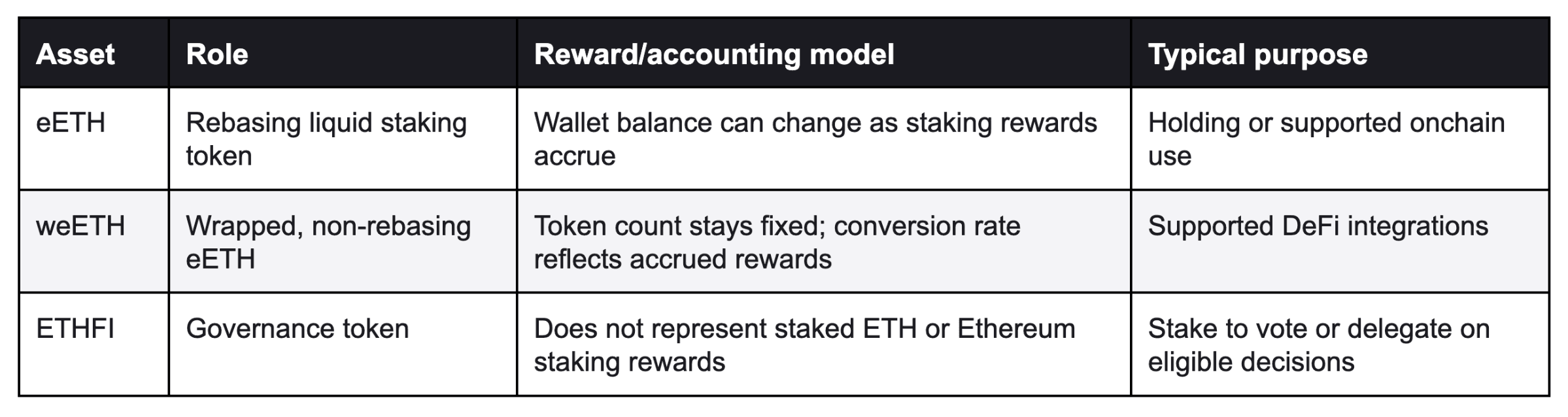
Users stake ETH through ether.fi and receive liquid staking tokens (eETH or weETH) that represent their staked position. The underlying ETH participates in Ethereum validation and earns staking rewards. The tokens can remain transferable and usable across supported DeFi markets, so staked ETH stays liquid instead of locked.
Liquid
ether.fi Liquid provides automated onchain strategies through vaults. Users can deposit supported assets into eligible strategies, which can allocate assets across selected onchain protocols and strategies.Current available vaults are EUR, USD RWAs, ETH, BTC, USD and Gold (coming soon.)
Cash
ether.fi Cash provides supported payment and card functionality. Depending on the user's location, eligibility, and selected payment mode, users can spend supported balances or access borrowing against eligible collateral.
Borrowing
ether.fi allows eligible users to borrow against supported collateral without first selling the underlying assets. Borrowing is overcollateralized, and the amount available depends on the assets deposited and their applicable loan-to-value limits. Interest rates and collateral requirements can vary, and collateral may be liquidated if a borrowing position becomes unhealthy.
Security
ether.fi is designed with a focus on user control and security. Its staking infrastructure operates on the Ethereum blockchain, leveraging the network’s decentralized architecture
eETH and weETH Token Overview
eETH and weETH both represent staked ETH within the ether.fi ecosystem, but they use different accounting models. Neither is the ether.fi governance token.
ETHFI Token Overview
ETHFI is the governance token of the ether.fi ecosystem. It can be used for governance participation, allowing eligible community members to have a role in decisions affecting the protocol.
ETHFI governance can cover areas such as protocol parameters, treasury management, and other aspects of the ether.fi ecosystem, depending on the governance mechanisms in place.
More information on the token can be found at ether.fi
Benefits of Using Ether.fi
ether.fi offers several potential benefits for users looking to participate in decentralized staking and other onchain activities, including:
Potential Returns from Staking
By staking ETH through ether.fi, users can participate in Ethereum staking and may receive staking rewards. The amount of rewards can vary based on network conditions, validator performance, protocol fees, and other factors.
More information on ether.fi’s staking programme can be found at ether.fi. Please ensure you are familiar with staking and Ether.fi’s Terms of Service.
Liquidity of Assets
ether.fi provides liquid staking tokens such as eETH and weETH. These tokens can remain transferable and may be used in supported DeFi applications while representing a staked ETH position.
Additional Onchain Features
Beyond staking, ether.fi provides features such as automated strategies, payments, and borrowing against eligible assets. Availability and terms vary depending on the feature, asset, location, and user eligibility.
Participation in Governance
ETHFI is used for governance participation within the ether.fi ecosystem. Eligible users can participate in governance through available staking, voting, or delegation mechanisms.
How to add ETHFI and eETH to Trust Wallet
Did you know, you can import any token into your Trust Wallet? Here’s how:
Step 1: Open the Trust Wallet mobile app.
Step 2: Click on the “manage crypto” icon on the top right of your screen.
Step 3: Tap the “+” icon on the top right of your screen.
Step 4: Select the Ethereum network.
Step 5: Paste the correct contract address
Step 6: Click “import.”
Trust Wallet does not verify the accuracy of any contract address imported to our app. The above is provided as a starting point - please ensure you are familiar with the process and that you verify all addresses. You are responsible for the security of your own wallets and assets.
Join the Trust Wallet community on Telegram Follow us on X (formerly Twitter) Instagram Facebook Reddit
Note: Any cited numbers, figures, or illustrations are reported at the time of writing, and are subject to change.