

Polymarket is the world's largest decentralized prediction market platform, where users trade binary outcome shares on real-world events — political elections, economic indicators, sports results, entertainment outcomes, and cryptocurrency price movements. Founded in 2020 by Shayne Coplan, Polymarket operates on Polygon using USDC stablecoins, with shares priced between $0.01 and $1.00 reflecting the market's collective probability assessment of each outcome. The platform processed over $3.3 billion in trading volume during the 2024 U.S. presidential election alone. This guide explains how Polymarket works, how to access prediction markets through Trust Wallet, and what to know about the risks.
Key Takeaways
- Polymarket is the world's largest decentralized prediction market platform, operating on Polygon with USDC.
Founded in 2020 by Shayne Coplan; processed over $3.3 billion during the 2024 U.S. presidential election.
Binary outcome shares priced between $0.01 and $1.00 reflect the market's collective probability of each outcome.
Zero trading fees; settlement via decentralized oracles and a Market Integrity Committee.
Polymarket secured a $2 billion investment from Intercontinental Exchange (NYSE parent) in October 2025 at an $8 billion valuation.
Polymarket vs Kalshi — Quick Comparison
| Feature | Polymarket | Kalshi |
|---|---|---|
| Type | Decentralized (on-chain) | Centralized, CFTC-licensed |
| Currency | USDC stablecoin | US dollars |
| Blockchain | Polygon | None |
| US legal | Blocked (CFTC 2022 settlement) | Yes — operates in the US |
| Trading fees | 0% | Up to ~2% per trade |
| KYC required | No (email + auto-generated wallet) | Yes (US identity verification) |
| Custody | Self-custodial (you hold the keys) | Custodial (Kalshi holds funds) |
| Settlement | UMA oracle + Market Integrity Committee | Centralized resolution |
Polymarket vs Hyperliquid Markets — Quick Comparison
| Feature | Polymarket | Hyperliquid Markets (HIP-4) |
|---|---|---|
| Primary surface | Dedicated prediction-market platform | Perpetuals exchange · event markets added 2025 |
| Blockchain | Polygon | Hyperliquid Layer-1 |
| Settlement currency | USDC | USDC |
| Event-market history | Since 2020 (deep liquidity, 4+ years) | Newer (HIP-4 launched 2025) |
| Self-custodial | Yes | Yes |
| Trading fees | 0% | 0% |
| US legal status | Blocked (CFTC settlement) | Not available to US users |
| Trust Wallet access | Via Swaps.xyz routing | Native integration |
| Best for | Political + macro long-horizon bets | Crypto-native event markets alongside perps |
Both platforms are self-custodial and use USDC — but they target different user behaviors. Polymarket has deeper liquidity on political and entertainment events; Hyperliquid concentrates active crypto-native traders who want event markets in the same interface as their perps positions. Trust Wallet supports both.
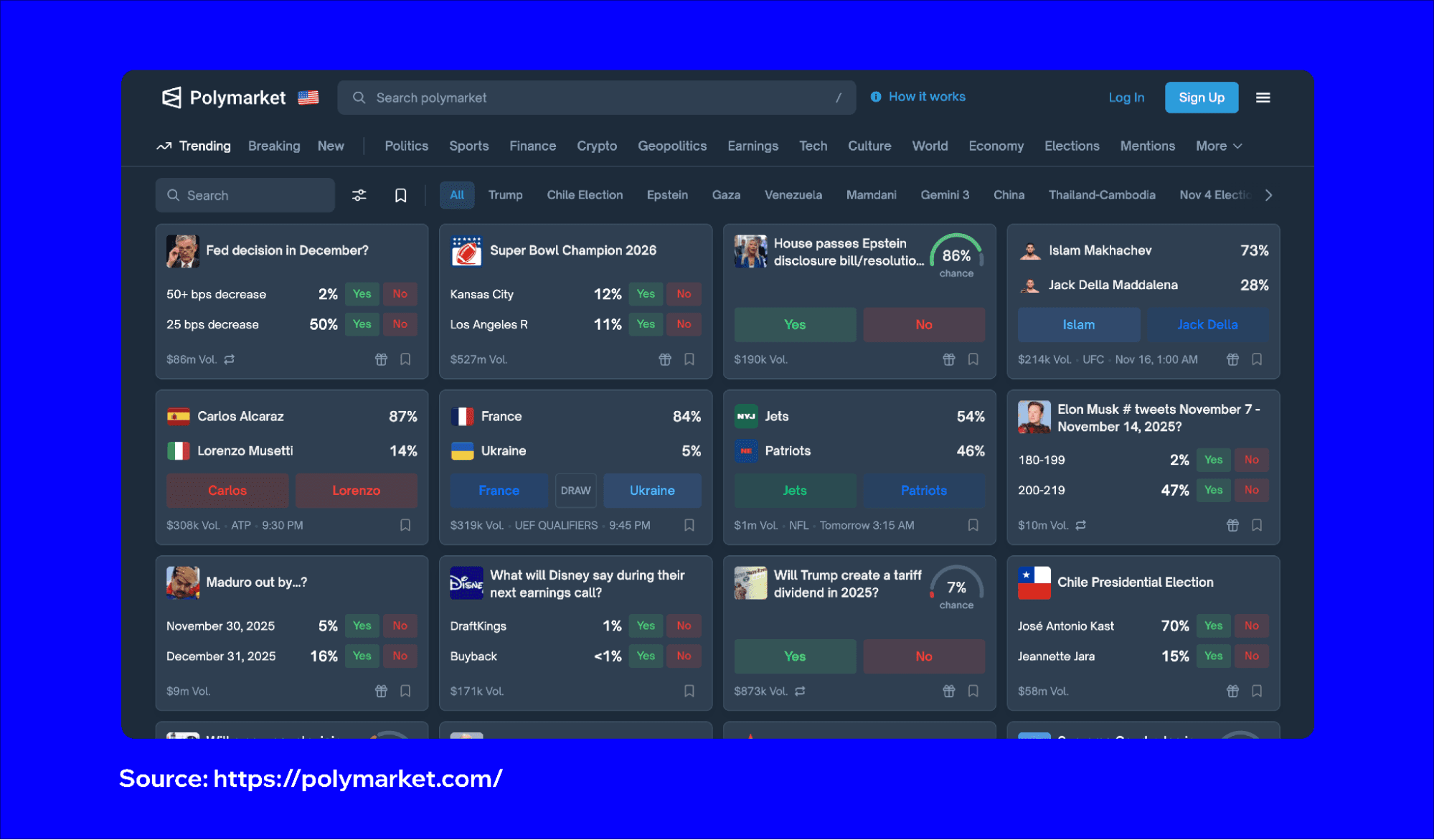
How Does Polymarket Work?
When you participate in Polymarket, you're purchasing outcome shares that represent the probability of specific events occurring. Each share is priced between $0.01 and $1.00, with the price reflecting the market's collective assessment of that outcome's likelihood. If a "Yes" share costs $0.70, the market believes there's a 70% chance that outcome will happen.
Polymarket creates markets around questions with verifiable yes-or-no outcomes. You choose which outcome you believe will occur and purchase shares accordingly. If your prediction proves correct when the market resolves, each share becomes worth $1.00. If you're wrong, your shares become worthless.
You can buy and sell shares at any time before markets close, providing flexibility to lock in profits or cut losses as new information emerges. This continuous trading creates dynamic markets that adjust in real-time, reflecting the latest developments and collective intelligence of all participants.
Polymarket uses decentralized oracles (UMA) to verify event outcomes and settle markets. In cases where outcomes are ambiguous, Polymarket's Market Integrity Committee makes final determinations, ensuring fair resolution. This automated settlement process removes the need for intermediaries and creates transparent, tamper-proof results.
Inside Trust Wallet, Polymarket markets are surfaced through Swaps.xyz, the event-market routing partner that aggregates multiple prediction providers. Swaps.xyz connects directly to Polymarket's markets on Polygon, enabling Trust Wallet to offer a seamless, unified trading interface across multiple vendors.
What Can You Predict on Polymarket?
Polymarket markets cover any real-world event with a verifiable yes-or-no outcome. Markets are organized into five primary categories:
Politics — US and global elections, policy decisions, leadership changes, geopolitical events. Polymarket's largest category by volume; the 2024 US presidential election alone drove over $3.3 billion.
Crypto — Bitcoin / Ethereum price targets, ETF approvals, network upgrades, token launches, hack outcomes.
Sports — championship outcomes, league standings, individual match results, transfers and contract decisions.
Entertainment — awards (Oscars, Grammys, Emmys), box-office milestones, release-date predictions, reality-TV outcomes.
Macroeconomic — Federal Reserve rate decisions, inflation prints, GDP growth, currency-pair movements.
Liquidity varies sharply across categories. Politics consistently has the deepest pools; entertainment and niche sports often have thinner markets where large trades can move prices. Before trading, check the visible bid-ask spread — wide spreads mean lower liquidity and worse exit pricing.
Background and Notable Markets
Polymarket was launched in 2020 by Shayne Coplan, then a 21-year-old college dropout from New York University. The platform gained significant mainstream recognition during the 2024 U.S. presidential election, recording over $3.3 billion in trading volume on that single event. Polymarket accurately predicted major outcomes — including Joe Biden's withdrawal from the race weeks before his official announcement and Donald Trump's eventual victory — demonstrating the power of market-based forecasting.
In October 2025, Polymarket secured a $2 billion investment from Intercontinental Exchange (parent company of the New York Stock Exchange), valuing the company at $8 billion. This institutional backing demonstrates growing mainstream acceptance of blockchain-based prediction markets.
Polymarket has announced plans to launch its native POLY token in the first quarter of 2026, with the top 20% of traders receiving an airdrop. This upcoming token launch creates additional incentives for active platform participation.
Why Trade on Polymarket?
Trading on Polymarket offers several distinct advantages that have attracted hundreds of thousands of users and positioned the platform as the dominant player in decentralized prediction markets. The blockchain foundation represents Polymarket's most significant strength, providing benefits impossible to replicate on traditional platforms.
The decentralized architecture means you maintain complete control over your funds through self-custodial wallets, including Trust Wallet. Polymarket never holds your assets, eliminating central points of failure and counterparty risk. Your private keys remain in your possession, giving you absolute ownership and the ability to withdraw funds at any time.
Polymarket operates with remarkable transparency compared to traditional prediction platforms. Every trade is recorded on the Polygon blockchain, creating a public, immutable record that anyone can verify. This transparency extends to market resolution, where the process follows clear rules verified through blockchain technology.
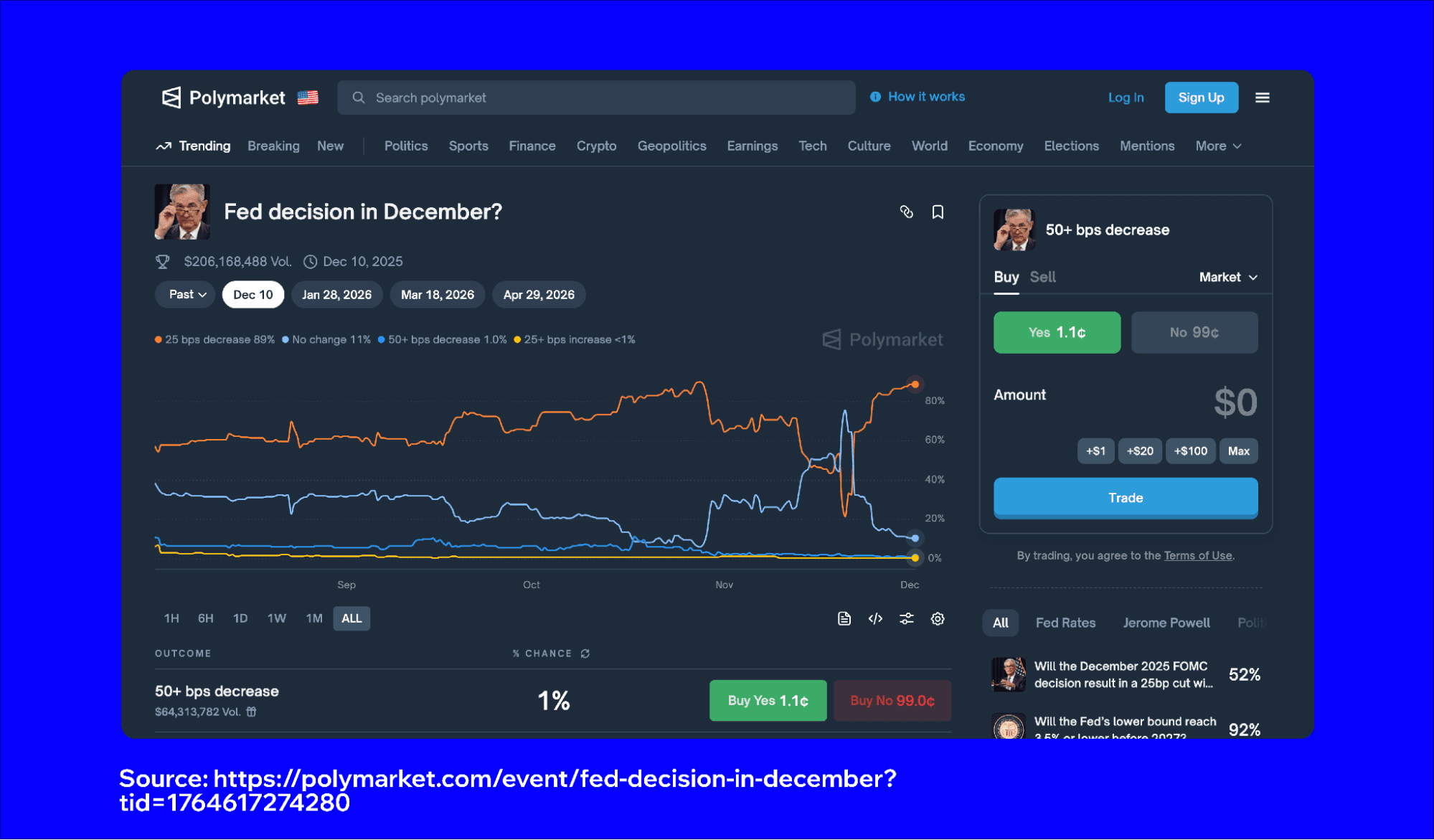
Key Benefits for Traders
Polymarket charges zero trading fees for buying and selling outcome shares, making it highly cost-effective for active traders. While you'll pay minimal network gas fees for deposits and withdrawals, Polymarket itself takes no cut from your trades. This fee structure stands in stark contrast to traditional betting platforms that often charge substantial commissions.
Polygon's Layer-2 technology provides near-instantaneous transactions with incredibly low gas fees. You can trade small amounts without being penalized by high transaction costs, making Polymarket accessible regardless of your capital size. This efficiency creates a smooth user experience comparable to centralized platforms while maintaining decentralization benefits.
Polymarket requires no KYC procedures, preserving your privacy while participating in markets. You can create an account with just an email address, and Polymarket generates a wallet for you automatically. This anonymity appeals to users who value privacy but want to participate in prediction markets.
With billions in lifetime trading volume and hundreds of thousands of active users, you can typically enter and exit positions efficiently. Major markets attract substantial participation, ensuring tight spreads and reliable execution.
Is Polymarket Safe?
Polymarket is generally safe to use as a non-custodial prediction-market platform — it has operated since 2020 without major smart-contract exploits, settles markets via the decentralized UMA oracle, and never holds custody of user funds. However, "safe" depends on four distinct factors you should evaluate separately:
Smart Contract Safety
Polymarket's core contracts have been live on Polygon since 2020 across hundreds of millions of dollars in trading volume without a known exploit. The contracts use established Ethereum/Polygon standards — a well-understood attack surface, not novel cryptography. As with any DeFi platform, residual smart-contract risk exists, but Polymarket has the longest clean operational record of any major decentralized prediction market.
Settlement Integrity
Outcomes are resolved by the UMA (Universal Market Access) decentralized oracle network, which uses economic incentives to produce honest results. In rare ambiguous cases, Polymarket's Market Integrity Committee provides final adjudication. This two-tier system is transparent and auditable on-chain — disputed resolutions go through a public process rather than a closed corporate decision.
Regulatory Standing
Polymarket is geo-blocked for users in the United States (per a 2022 CFTC settlement) and restricted in Switzerland, France, Poland, Singapore, Belgium and several other jurisdictions. The list changes as regulators worldwide adjust their stance on prediction markets. Verify the legal status in your country before trading — platform-level restrictions don't override local law, and some jurisdictions impose personal consequences on individuals who participate.
Financial Risk
Prediction markets are speculative by design. A wrong prediction results in total loss of the capital allocated to that share. Large individual trades can temporarily distort prices in lower-liquidity markets, and ambiguous resolution criteria can lead to losses even when your call was directionally right. Only trade amounts you can afford to lose completely.
Using Polymarket Through Trust Wallet
Accessing Polymarket through Trust Wallet preserves the safest property of the platform: self-custody. Your USDC stays in your wallet, you connect via Swaps.xyz routing, and Polymarket never holds your private keys. This is materially safer than centralized prediction-market alternatives where the platform holds your funds, because you remain in control of your assets even if the platform itself faces operational issues.
How to Access Prediction Markets in Trust Wallet
Connecting to prediction market platforms is simple using Trust Wallet. Follow these steps:
Open the Trust Wallet app.
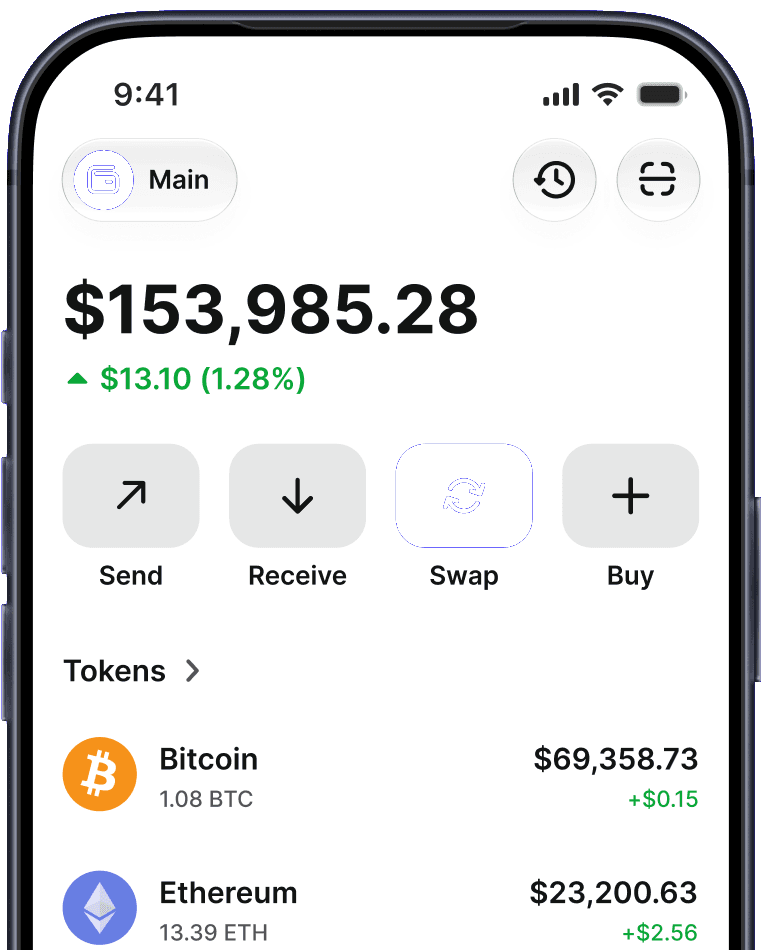
Access Predictions via the Trade menu option, and search for a prediction you'd like to trade on.
Select Yes or No to predict and then choose your amount.
Select Continue to complete the steps.
Once done, view and share your position.
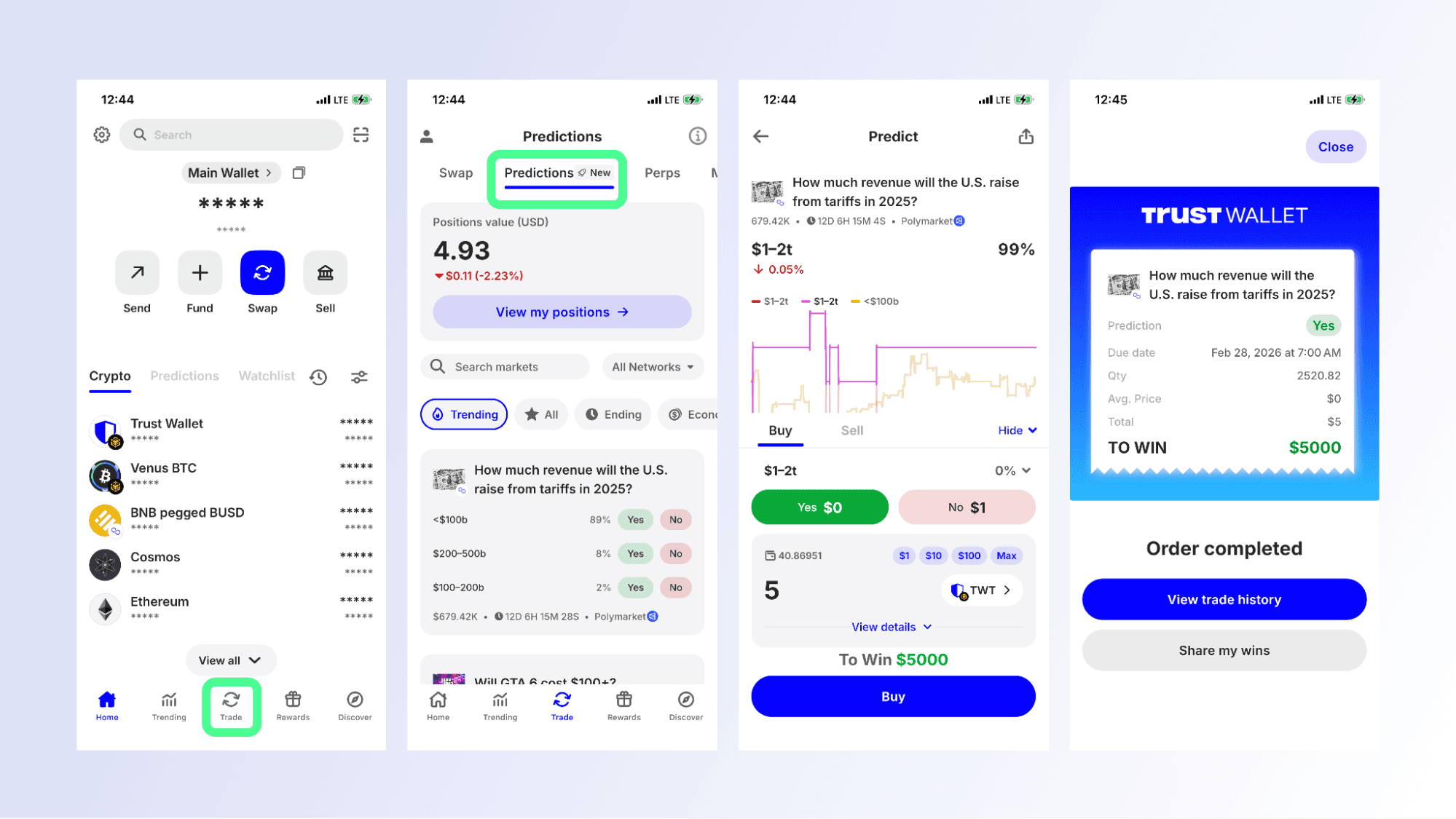
Trust Wallet uses Swaps.xyz to connect you to Polymarket markets on Polygon, making the entire experience native, self-custodial, and gas-efficient.
Important Risk Considerations
Prediction markets carry inherent risks that you must understand before participating. Market prices reflect collective opinion rather than guaranteed outcomes, and large individual trades can sometimes distort pricing. You should only trade amounts you can afford to lose completely, as incorrect predictions cause total loss of capital allocated to those positions.
Polymarket operates in a complex regulatory environment, settling with the CFTC in 2022 and agreeing to block U.S. users from accessing its services. Multiple countries including Switzerland, France, Poland, Singapore, and Belgium have subsequently blocked or restricted access to Polymarket. You must verify that prediction market participation complies with local laws before trading.
Smart contract risks exist whenever interacting with blockchain platforms. While Polymarket uses established technology, vulnerabilities could potentially affect market operations or fund security. The platform's decentralized nature means there's no central authority to reverse transactions if technical issues occur.
Frequently Asked Questions About Polymarket
Information below is educational and not investment or legal advice. Prediction market participation is restricted or illegal in many jurisdictions — verify the rules where you live before participating.
Is Polymarket legal in the United States? No. Polymarket settled with the U.S. Commodity Futures Trading Commission (CFTC) in 2022 and agreed to block U.S. users from accessing its services. As of today, Polymarket markets are geo-restricted for users connecting from the United States. Attempting to bypass these restrictions through VPNs is against Polymarket's terms of service and may carry legal consequences. U.S. residents who want regulated prediction markets typically use Kalshi, which is licensed by the CFTC to operate domestically.
Where else is Polymarket blocked or restricted? In addition to the United States, Polymarket access is blocked or restricted in Switzerland, France, Poland, Singapore, Belgium, and several other jurisdictions. The list changes as regulators around the world adapt their stance on prediction markets. Polymarket's geo-restrictions are enforced at the platform level — local laws may impose additional consequences on individuals who participate. Always verify the legal status of prediction markets in your country before trading.
How does Polymarket make money if it charges zero trading fees? Polymarket does not collect commissions on individual trades. Its current revenue model is primarily backed by venture funding — most recently the $2 billion investment from Intercontinental Exchange (NYSE parent) at an $8 billion valuation in October 2025. The upcoming POLY token launch (Q1 2026) is expected to introduce additional value-capture mechanics, potentially through staking, governance, or protocol-level fees.
What is the difference between Polymarket and Kalshi? Polymarket is decentralized — built on the Polygon blockchain, settled with USDC stablecoins, self-custodial, and not legal for U.S. users. Kalshi is centralized and CFTC-licensed — it operates in U.S. dollars, requires KYC verification, charges trading fees (up to ~2%), and is fully legal in the United States. Polymarket has historically had higher trading volume on global political events; Kalshi covers a similar topic range but within U.S. regulatory boundaries.
How does Polymarket compare to Hyperliquid prediction markets? Polymarket is a dedicated prediction-market platform on Polygon. Hyperliquid is primarily a decentralized perpetual-futures exchange on its own Layer-1 blockchain, and recently introduced event markets via the HIP-4 standard. Polymarket offers deeper liquidity and a longer history on political and macro events; Hyperliquid integrates event markets alongside perps trading in a unified interface. Both are self-custodial and use USDC, but they target different primary user behaviors. Trust Wallet supports both surfaces.
Is Polymarket safe to use? Polymarket itself has operated since 2020 without major smart-contract exploits, and its UMA oracle and Market Integrity Committee settle markets transparently. That said, prediction markets carry inherent risks: a wrong prediction means total loss of capital allocated to that share, large trades can temporarily distort pricing, and smart-contract risk always exists on any DeFi platform. When using Polymarket through a self-custodial wallet like Trust Wallet, your funds remain in your control — Polymarket never holds custody of your assets.
Has Polymarket ever been hacked or exploited? No major smart-contract exploit has been recorded on Polymarket since its 2020 launch. The platform has operated continuously across hundreds of millions of dollars in trading volume without a known protocol-level breach. Individual users have lost funds to phishing or seed-phrase mistakes (the usual self-custody risks that apply to any DeFi platform), but Polymarket's core contracts themselves have not been compromised. Compare this to numerous centralized prediction markets that have either shut down or suffered insolvency events — Polymarket's open-source, on-chain design has been a meaningful structural advantage.
Can I lose more money than I deposit on Polymarket? No. The maximum you can lose on any single Polymarket position is the amount you spent to purchase outcome shares. Polymarket does not offer leverage, margin trading, or perpetual contracts — every position is fully collateralized at the moment of purchase. This is a fundamental design difference from perpetuals exchanges (where liquidation can drain margin) and centralized betting platforms (which sometimes extend credit). Your downside is capped at your buy-in.
Which countries are allowed to use Polymarket? Polymarket is accessible to most countries globally except for the United States (blocked since the 2022 CFTC settlement), Switzerland, France, Poland, Singapore, Belgium, and a handful of others where prediction markets face specific regulatory restrictions. The current geo-restriction list is enforced at the platform level and can change as regulations evolve. Always verify both Polymarket's terms of service and your local laws before participating — using a VPN to bypass restrictions violates Polymarket's terms and may carry separate legal consequences in your jurisdiction.
How do I deposit and withdraw money on Polymarket? Polymarket operates with USDC on the Polygon network. To deposit, you fund a Polymarket-connected wallet with USDC on Polygon — either by purchasing USDC directly on Polygon, or by bridging USDC from Ethereum or another supported chain. To withdraw, you transfer USDC from your Polymarket wallet to any external Polygon-compatible wallet (such as Trust Wallet), then optionally bridge or off-ramp to fiat. Network gas fees are minimal because Polygon is a Layer-2 scaling solution.
What is the POLY token and when does it launch? POLY is Polymarket's announced native token, scheduled to launch in the first quarter of 2026. The top 20% of historical Polymarket traders are slated to receive an airdrop. Token utility is expected to include governance, fee discounts, and potential staking — full specifications will be confirmed at launch. As with any token launch, market reception and price action are speculative; the announcement itself has driven increased trading activity on the platform in the lead-up.
How accurate have Polymarket's predictions been? Polymarket markets accurately forecast several major outcomes during the 2024 U.S. presidential election cycle, including Joe Biden's withdrawal from the race weeks before his official announcement and Donald Trump's eventual victory. Academic research on prediction markets generally shows them outperforming polling and expert forecasts when liquidity is sufficient — because market participants put real capital behind their predictions. Accuracy is not guaranteed, however: low-liquidity markets, ambiguous resolution criteria, and large single-trader positions can all distort pricing.
Disclaimer: Content is for informational purposes and not investment advice. Web3 and crypto come with risk. Please do your own research with respect to interacting with any Web3 applications or crypto assets. View our terms of service.
Join the Trust Wallet community on Telegram. Follow us on X (formerly Twitter), Instagram, Facebook, Reddit, Warpcast, and Tiktok
Note: Any cited numbers, figures, or illustrations are reported at the time of writing, and are subject to change.