

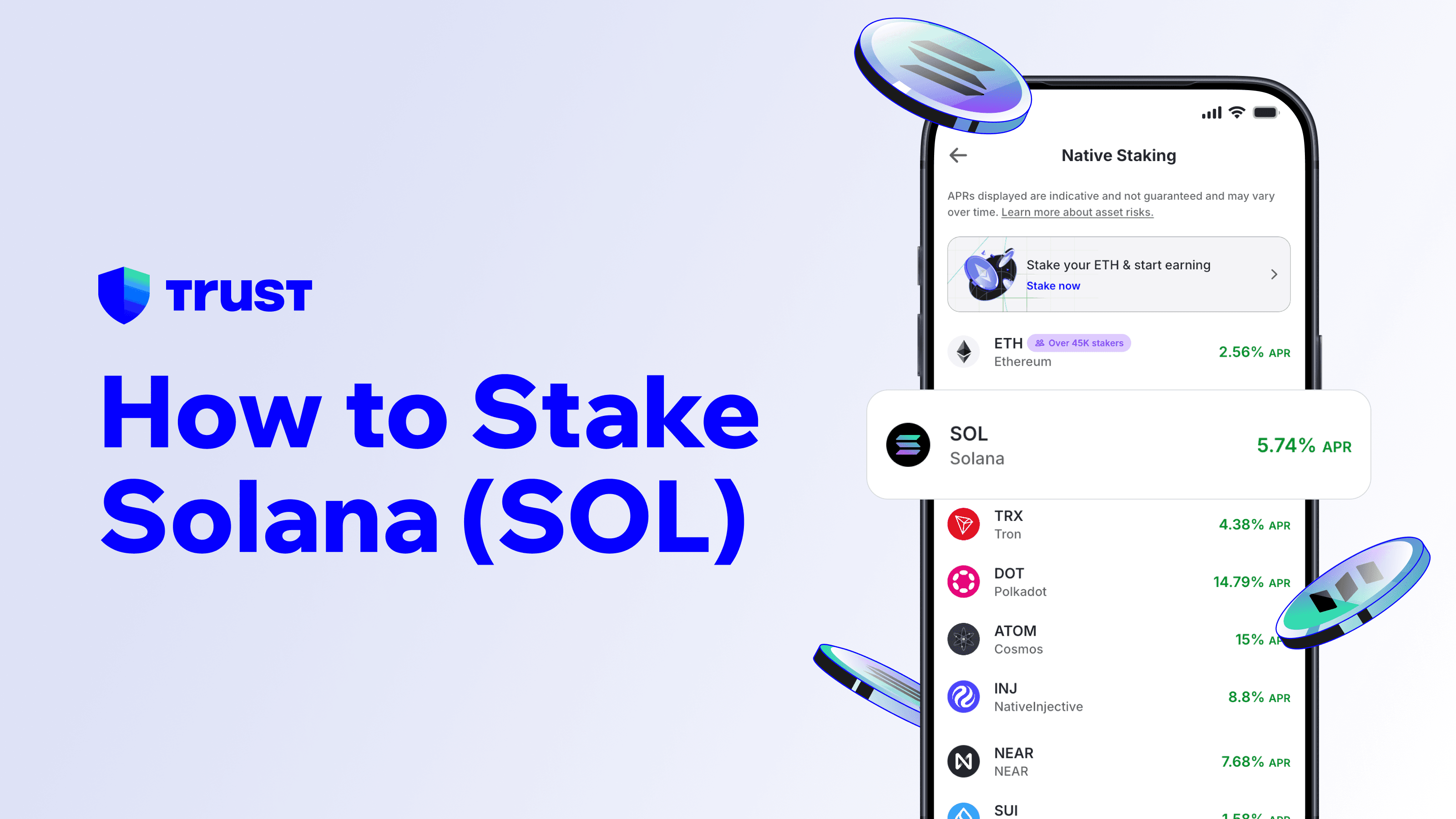
Staking Solana (SOL) means delegating your coins to a validator — your SOL never leaves your wallet, and the validator never takes custody of it. Rewards are paid every epoch, and when you unstake, your coins become available at the end of the current epoch, which typically means a wait of roughly 2–3 days in normal conditions. It is one of the simplest staking experiences of any major blockchain.
What Is Solana Staking?
Solana is a proof-of-stake network secured by validators who process transactions and produce blocks. The more SOL delegated to a validator, the more often it is selected to do that work and earn rewards. By delegating your SOL, you increase a validator's weight and receive a proportional share of its rewards, minus a commission the validator keeps.
Delegation is non-custodial by design. Your SOL stays at an address controlled by your keys; the validator only gains voting weight, never spending power over your coins.
How Do I Stake SOL Step by Step?
From a self-custody wallet, staking SOL takes a few minutes:
Set up the wallet and back up your secret recovery phrase offline.
Add SOL to your wallet, leaving a small amount unstaked to cover fees.
Open the SOL asset, choose Stake, pick an amount and confirm.
Your stake activates at the next epoch boundary and starts earning from then on.
Rewards accrue each epoch and compound into your staked balance automatically — reward amounts are variable and not guaranteed.
The delegation is a normal on-chain transaction signed by your own keys.
How Do I Choose a Solana Validator?
Most wallets suggest reliable validators, but it helps to know what "reliable" means. Look for high uptime — a validator that goes offline earns nothing during that time, and neither do you. Check the commission rate, which is the percentage of rewards the validator keeps. And prefer validators with a meaningful history over brand-new ones. A slightly lower commission rarely compensates for poor uptime, so weight reliability first.
Delegating to smaller established validators also helps decentralize the network, since stake concentrated in a few giants makes Solana less resilient. You can change your mind later: switching validators simply means deactivating your current delegation and re-delegating, with the same epoch timing applying to each step.
What Is an Epoch and How Long Does Unstaking Take?
An epoch is Solana's reward and accounting cycle, lasting roughly two to three days. Two things happen on epoch boundaries: staking rewards are distributed, and stake activations or deactivations take effect.
When you unstake, your SOL enters a deactivating state and becomes fully withdrawable at the end of the current epoch. That makes Solana one of the faster major networks to exit — compare BNB Chain's 7-day unbonding period or TRON's 14 days. Still, you cannot sell instantly, so keep any SOL you may need immediately outside your stake.
Is Staking SOL Safe?
Delegating SOL gives the validator no spending power over it — it stays at your address throughout. The remaining risks are the standard ones: the price of SOL can move while you are staked, and your coins are unavailable during the deactivation wait. Poorly performing validators cost you rewards — Solana does not currently apply automatic in-protocol slashing penalties, though network rules can change. Favoring established operators still matters: validator downtime directly reduces what you earn. The most important safety factor is unrelated to staking itself — protect your secret recovery phrase, because anyone who has it controls your entire wallet. The staking glossary entry covers the general risk picture in more depth.
Staking SOL with Trust Wallet
Trust Wallet supports SOL staking directly in the app: open the asset, choose Stake, pick an amount and confirm, and your delegation goes on-chain from keys only you control. The wallet is self-custody, used by millions of people worldwide, and supports staking for ETH, BNB, TRX, ADA, DOT, and more alongside SOL. Its built-in Security Scanner checks transactions against known risk signals and warns you before you sign — a prompt to look closer, not a guarantee. Get started on the Solana staking page, or see every supported asset at the Trust Wallet staking hub.
Disclaimer: Content is for informational purposes and not investment, financial, or tax advice. Web3 and crypto come with risk. Please do your own research with respect to interacting with any Web3 applications or crypto assets. View our terms of service.