


What Is DeFi?
DeFi — Decentralized Finance — is a broad term for financial services built on public blockchains that operate without banks, brokers, or any central authority. Instead of relying on institutions to hold your money, process transactions, or approve loans, DeFi uses smart contracts — self-executing code on the blockchain — to automate these functions transparently and permissionlessly.
DeFi emerged in 2018-2019 on Ethereum and exploded in adoption during the "DeFi Summer" of 2020. Today, DeFi protocols manage tens of billions of dollars in Total Value Locked (TVL) across Ethereum, BNB Chain, Solana, Arbitrum, Avalanche, and dozens of other chains.
Anyone with a crypto wallet and an internet connection can access DeFi. There are no credit checks, no bank accounts required, no geographic restrictions, and no opening hours — DeFi runs 24/7, globally.
How Does DeFi Work?
Traditional finance relies on trusted intermediaries:
A bank holds your money and processes transfers
A broker executes your trades
A lender evaluates your creditworthiness before issuing a loan
DeFi replaces each of these with smart contracts:
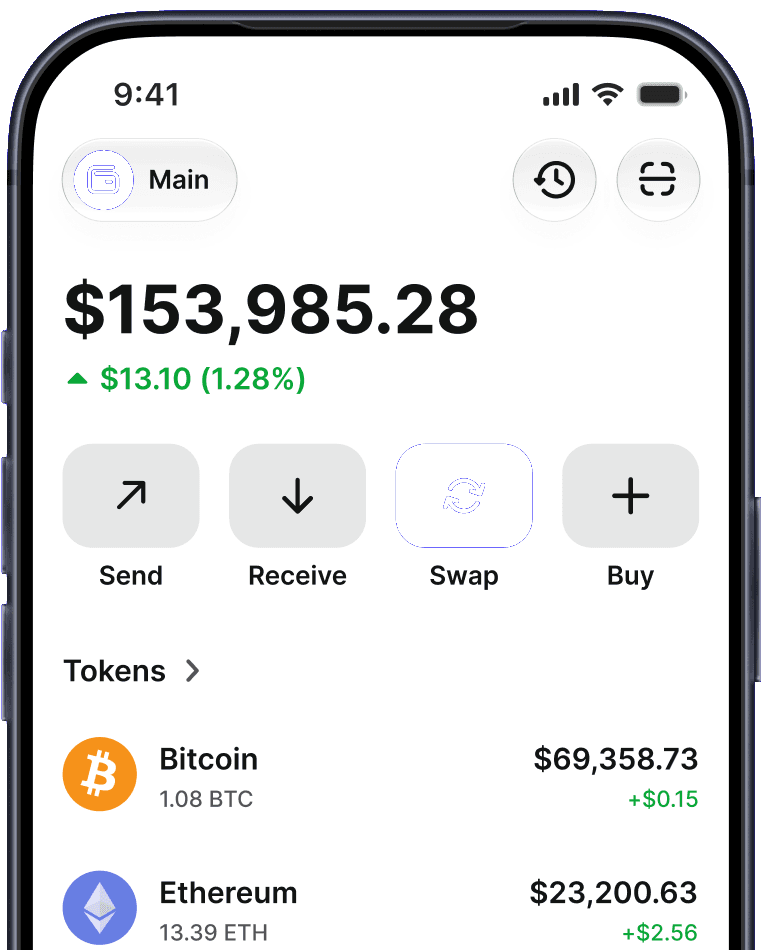
You connect your wallet (like Trust Wallet) to a DeFi protocol.
You interact directly with the smart contract — depositing, borrowing, swapping, or staking tokens.
The smart contract executes the logic automatically based on its code (e.g., matching a trade, calculating interest, distributing rewards).
The transaction is recorded on the blockchain, publicly verifiable by anyone.
You retain custody of your assets throughout — no third party ever holds your funds.
No middleman takes a cut or has the power to freeze your account. The rules are enforced by code, not by institutions.
Core DeFi Categories
Decentralized Exchanges (DEXs)
DEXs let you swap tokens directly from your wallet without creating an account or trusting a centralized platform with your funds.
| DEX | Chain(s) | Model |
|---|---|---|
| **Uniswap** | Ethereum, Polygon, Arbitrum, Base | Automated Market Maker (AMM) |
| **PancakeSwap** | BNB Chain, Ethereum, Arbitrum | AMM |
| **Jupiter** | Solana | Aggregator (routes across multiple DEXs) |
| **Curve** | Ethereum, multi-chain | AMM optimized for stablecoins |
| **dYdX** | Cosmos (own chain) | Order book (perpetual futures) |
How AMMs work: Instead of matching buyers and sellers (order book), AMMs use liquidity pools — pairs of tokens deposited by users. When you swap Token A for Token B, the smart contract automatically calculates the price based on the ratio of tokens in the pool.
Lending and Borrowing
DeFi lending protocols let you earn interest by depositing crypto, or borrow crypto by providing collateral — all without a bank or credit check.
| Protocol | Chain(s) | Specialty |
|---|---|---|
| **Aave** | Ethereum, Polygon, Arbitrum, Avalanche | Multi-asset lending, flash loans |
| **Compound** | Ethereum | Algorithmic interest rates |
| **Venus** | BNB Chain | Lending + stablecoin minting |
| **Morpho** | Ethereum | Peer-to-peer lending optimization |
How it works:
Lending: Deposit crypto into a lending pool. Borrowers pay interest. You earn a share of that interest proportional to your deposit.
Borrowing: Deposit collateral (e.g., ETH), borrow a different asset (e.g., USDC). You must maintain a minimum collateral ratio — if the value of your collateral drops too far, it gets automatically liquidated.
Liquid Staking
Protocols that let you stake tokens and receive a liquid receipt token in return, so you can earn staking rewards while still using your assets in DeFi.
Lido (stETH) — Stake ETH, receive stETH that earns rewards and can be used in DeFi
Rocket Pool (rETH) — Decentralized ETH staking
Jito (JitoSOL) — Solana liquid staking with MEV rewards
Yield Aggregators
Protocols that automatically move your assets between DeFi strategies to maximize returns.
Yearn Finance — Auto-compounds yield from lending and liquidity provision
Beefy Finance — Multi-chain yield optimizer
Stablecoins
Decentralized stablecoins are a DeFi primitive — tokens that maintain a stable value using smart contract mechanisms rather than bank reserves.
DAI — Backed by over-collateralized crypto deposits in MakerDAO vaults
FRAX — Partially algorithmic, partially collateralized
crvUSD — Curve's stablecoin backed by crypto collateral with soft-liquidation mechanism
DeFi vs Traditional Finance
| Feature | DeFi | Traditional Finance |
|---|---|---|
| Access | Anyone with a wallet (permissionless) | Requires bank account, ID, credit check |
| Operating hours | 24/7/365 | Business hours, weekdays |
| Custody | You control your funds (non-custodial) | Institution holds your funds |
| Transparency | All transactions public on-chain | Opaque, private ledgers |
| Settlement | Minutes (on-chain confirmation) | Days (T+1 to T+3 for securities) |
| Interest rates | Market-driven by supply and demand | Set by central banks and institutions |
| Geographic access | Global, borderless | Restricted by jurisdiction |
| Identity required | No (pseudonymous) | Yes (KYC/AML) |
| Regulation | Minimal, evolving | Heavily regulated |
| Insurance | Limited (protocol-specific) | Government-backed (FDIC, etc.) |
Key DeFi Concepts
Total Value Locked (TVL)
The total amount of assets deposited in a DeFi protocol. TVL is the primary metric for measuring a protocol's adoption and trust. Higher TVL generally indicates more confidence from users.
Impermanent Loss
A risk specific to liquidity providers on AMM-based DEXs. When the price ratio of the two tokens in your liquidity pool changes significantly, you may end up with less value than if you had simply held the tokens. The loss is "impermanent" because it reverses if prices return to their original ratio.
Flash Loans
Uncollateralized loans that must be borrowed and repaid within a single blockchain transaction. If the loan is not repaid by the end of the transaction, the entire operation is reversed. Flash loans are used for arbitrage, liquidations, and collateral swaps.
Composability
DeFi protocols can interact with each other like building blocks. You can deposit ETH in Lido (get stETH), use stETH as collateral on Aave (borrow USDC), then provide USDC liquidity on Curve — all in a chain of smart contract interactions. This composability is often called "money legos."
Risks of DeFi
Smart contract risk — Bugs in code can be exploited, leading to loss of funds. Always check if protocols have been audited.
Impermanent loss — Liquidity providers may lose value relative to simply holding their tokens.
Liquidation risk — Borrowers can lose their collateral if market prices move against them.
Oracle manipulation — DeFi relies on oracles (like Chainlink) for price data. If an oracle is manipulated, protocols can be exploited.
Regulatory uncertainty — DeFi regulation is evolving globally and may impact protocol access or token classifications.
Rug pulls — Unaudited or anonymous projects may drain user funds. Stick to established, audited protocols.
DeFi and Trust Wallet
Trust Wallet connects you directly to the DeFi ecosystem. You can swap tokens on decentralized exchanges, interact with lending protocols, provide liquidity, stake assets, and explore dApps across Ethereum, BNB Chain, Solana, and 100+ other chains — all through the built-in dApp browser. Trust Wallet is non-custodial, meaning your assets remain under your control at every step. No intermediary, no permission needed.