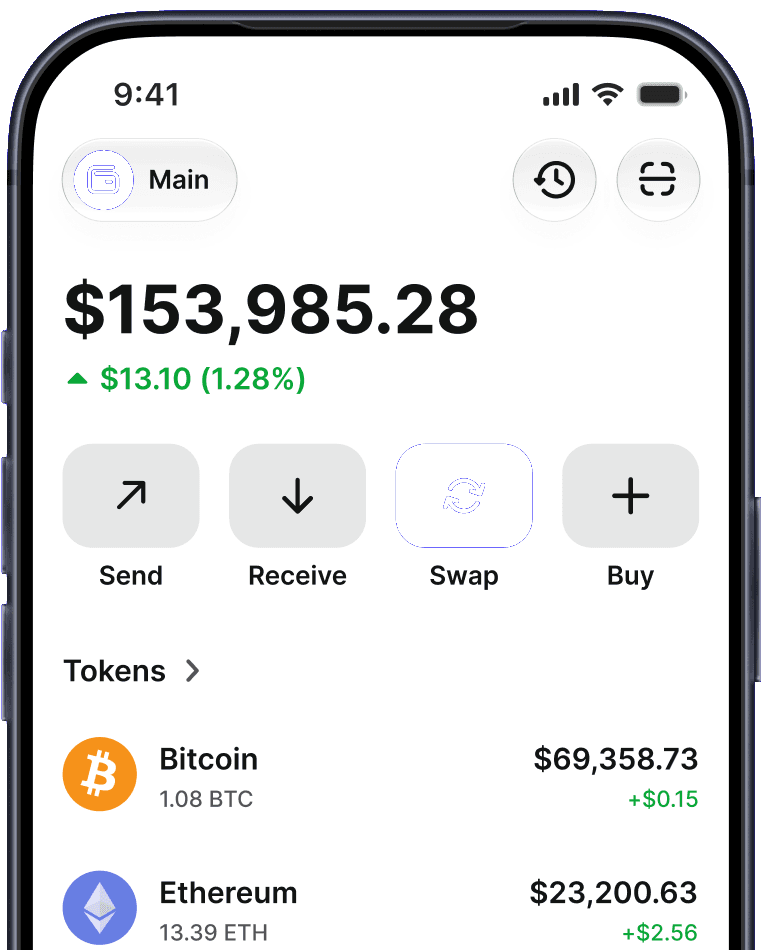


Ganha Ethereum com a
Trust Wallet
Fazer staking de Ethereum (ETH) significa bloquear as tuas moedas para ajudar a proteger a rede e, em troca, ganhar recompensas. A Trust Wallet permite-te fazer staking de Ethereum (ETH) com apenas alguns toques, ao mesmo tempo que manténs a auto-custódia total: controla as tuas chaves, as tuas moedas e as tuas recompensas.

Como utilizar a tua Trust Wallet para ganhar Ethereum
1. Seleciona a opção Earn.
2. Escolhe Ethereum (ETH) e seleciona “Fazer staking”.
3. Seleciona o montante do qual queres fazer staking.
4. Escolhe o validador (fornecedor de staking) e confirma.
ComeçarAvaliador de Ganhos
Potenciais ganhos com a TAE atual*
Ganhos Diários
+ 0 ETH
Rendimentos Mensais
+ 0 ETH
Ganhos Anuais
+ 0 ETH
25+ opções de staking na carteira*
 EthereumAPR 2.56%
 SolanaAPR 6.67%
 TronAPR 4.40%
 PolkadotAPR 14.67%
 BNB Smart ChainAPR 1.09%
 CosmosAPR 14.77%
 NativeInjectiveAPR 8.52%
 NEARAPR 8.05%
 SuiAPR 1.47%
 OsmosisAPR 1.96%
 TerraAPR 15.00%
 NativeZetaChainAPR 8.99%
 CardanoAPR 4.69%
 NativeEvmosAPR 0.00%
 StargazeAPR 0.00%
 CryptoOrgAPR 3.98%
 KavaAPR 7.49%
 KusamaAPR 15.46%
 StrideAPR 1.17%
 TezosAPR 2.17%
 JunoAPR 25.85%
 AkashAPR 3.79%
 AgoricAPR 0.00%
 AxelarAPR 12.98%
 SeiAPR 3.82%


Contribui para a Blockchain

Participa na segurança e na descentralização da rede.
Sabe mais sobre a DeFi

Explora mais chains e expande a tua jornada de ganhos na DeFi.
Explore Ethereum (ETH)
Track the live Ethereum price, convert ETH to USD and other currencies, and buy Ethereum — all in self-custody inside Trust Wallet. Your keys, your crypto, across iOS, Android, and the browser extension.
Ethereum price
Live ETH price, market cap, trading volume, and historical charts.
ETH to USD converter
Convert Ethereum to USD and 100+ fiat currencies with live rates.
Ethereum wallet
Store, send, and receive ETH in self-custody on iOS, Android, and browser.
Buy Ethereum
Buy ETH with a card, bank transfer, or Apple Pay in minutes.
A Trust Wallet é uma das carteiras de criptomoedas de auto-custódia com melhor classificação.
Classificada com 4.7 na App Store e com 4.6 no Google Play, com base em 2.7M avaliações verificadas, com a confiança de milhões de utilizadores no iOS e Android.


Perguntas frequentes
- O staking envolve o bloqueio das tuas criptomoedas para participares na manutenção e proteção de uma rede de blockchain. Ao fazê-lo, ajudas a manter a rede descentralizada e robusta contra ataques. Em troca, recebes recompensas tais como moedas adicionais. É mais do que uma forma de desenvolveres o teu portfólio: estás a contribuir ativamente para a saúde da rede.
- No staking, um validador é um nó que participa na manutenção da blockchain ao validar transações e criar novos blocos. Garante a integridade da rede e recebe recompensas de staking pelo seu trabalho.
- O staking envolve o bloqueio das tuas criptomoedas on-chain para ajudar a proteger e operar a rede da blockchain, oferecendo recompensas pela tua participação. Empréstimo é o ato de emprestar criptomoedas, na on-chain ou off-chain, para receberes juros. O cultivo de rendibilidade é uma atividade on-chain mais complexa, na qual forneces liquidez em protocolos de finanças descentralizadas para, potencialmente, receberes rendimentos. Com a Trust Wallet podes fazer staking sem saíres da carteira. Também podes associar qualquer dApp Web3 que ofereça oportunidades de ganhos, tais como empréstimos e protocolos de cultivo de rendibilidade.
- Ao utilizares a Trust Wallet, estás a interagir diretamente com protocolos descentralizados, quer decidas utilizar as opções de ganhos na carteira ou oportunidades de ganhos através de dApps Web3. Os riscos podem incluir vulnerabilidades dos contratos inteligentes, volatilidade do mercado ou outros fatores. A Trust Wallet é uma interface para estes serviços e não controla os protocolos subjacentes. É importante que realizes a tua própria pesquisa antes de fazeres staking com qualquer protocolo.
- Ethereum staking through Trust Wallet is non-custodial — your ETH stays in your wallet at all times. Trust Wallet never holds your private keys or your staked balance. The main risks are validator slashing (if you delegate to a misbehaving validator), smart-contract bugs (where applicable for liquid-staking protocols), and ETH market price volatility during the staking period. Choose validators with high uptime, reasonable commission rates, and a clean operational track record to minimize slashing risk.
- Your principal ETH cannot be confiscated by Trust Wallet — you retain full self-custody. However, partial losses can occur in two specific scenarios: (1) slashing, where the network protocol penalizes validators for misbehavior (downtime or double-signing) and reduces a portion of all delegated stake; (2) market price drops — if ETH falls in price during the staking or unstaking period, the fiat value of your holdings declines even though your token quantity stays the same. Slashing on most major networks is rare and capped at small percentages for routine offenses.
- Yes. Trust Wallet is fully non-custodial — your private keys never leave your device and your staked ETH remains attributable to your wallet address on-chain at all times. Trust Wallet acts as the interface for delegating to validators; it does not hold, transfer, or have any authority over your funds. You can verify your delegation balance directly on a public blockchain explorer using your wallet address.
- Unstaking periods are set by each blockchain's protocol, not by Trust Wallet. Common ranges across major networks: Ethereum (validator-exit queue + withdrawal, typically days to weeks depending on network conditions), Solana (cooldown ~1–2 epochs, roughly 2–4 days), Cosmos / ATOM (21 days), Polkadot / DOT (28 days), Tron / TRX (14 days). During the unstaking period your ETH is locked and stops earning rewards. Plan ahead if you may need liquidity before the lockup ends.
- If a validator commits a slashable offense — extended downtime, or signing two conflicting blocks — a percentage of all delegated stake (including yours) can be burned by the network protocol. Slashing severity varies by network: typically 0.5–1% for downtime, and up to 5–100% for severe double-signing offenses. To minimize this risk, delegate to established validators with high uptime (>99%), reasonable commission rates, and a clean track record. You can switch validators at any time, but the unstaking period applies before you can re-delegate the affected stake.