


What Is Bitcoin?
Bitcoin (BTC) is the world's first cryptocurrency — a decentralized digital currency that enables peer-to-peer transactions without the need for banks, governments, or any central authority. It was introduced in 2008 through a whitepaper titled "Bitcoin: A Peer-to-Peer Electronic Cash System" published by the pseudonymous Satoshi Nakamoto, and the network went live on January 3, 2009.
Bitcoin remains the largest cryptocurrency by market capitalization and is widely regarded as "digital gold" — a store of value and hedge against inflation due to its fixed supply of 21 million coins.
How Does Bitcoin Work?
Bitcoin runs on its own blockchain — a public, distributed ledger maintained by thousands of nodes worldwide.
A user sends BTC from their wallet by creating a transaction signed with their private key.
The transaction is broadcast to the Bitcoin network.
Miners compete to validate the transaction by solving a complex mathematical puzzle (Proof of Work).
The first miner to solve the puzzle adds the transaction to a new block and broadcasts it to the network.
Other nodes verify the block and add it to their copy of the blockchain.
The miner receives a block reward (currently 3.125 BTC after the 2024 halving) plus transaction fees.
The entire process takes approximately 10 minutes per block. No single entity can reverse, censor, or modify confirmed transactions.
Key Properties of Bitcoin
Fixed Supply
There will only ever be 21 million BTC. This hard cap is enforced by the protocol's code and cannot be changed. As of 2025, approximately 19.8 million BTC have already been mined.
Halving
Approximately every four years (every 210,000 blocks), the block reward miners receive is cut in half. This event is called the Bitcoin halving and it reduces the rate of new BTC entering circulation.
| Halving | Year | Block Reward |
|---|---|---|
| Genesis | 2009 | 50 BTC |
| 1st | 2012 | 25 BTC |
| 2nd | 2016 | 12.5 BTC |
| 3rd | 2020 | 6.25 BTC |
| 4th | 2024 | 3.125 BTC |
| 5th (est.) | 2028 | 1.5625 BTC |
Decentralization
No company, government, or individual controls Bitcoin. The network is maintained by thousands of independent nodes and miners across the globe.
Pseudonymity
Bitcoin transactions are tied to wallet addresses, not real-world identities. While all transactions are publicly visible on the blockchain, the identity behind each address is not automatically revealed.
Bitcoin vs Other Cryptocurrencies
| Feature | Bitcoin (BTC) | Ethereum (ETH) | Stablecoins (USDT) |
|---|---|---|---|
| Primary purpose | Store of value, digital money | Smart contract platform | Price-stable payments |
| Consensus | Proof of Work | Proof of Stake | Varies by chain |
| Supply cap | 21 million (fixed) | No hard cap (with burn mechanism) | Pegged to fiat (unlimited issuance) |
| Block time | ~10 minutes | ~12 seconds | Depends on underlying chain |
| Smart contracts | Limited (Bitcoin Script) | Full Turing-complete (Solidity) | Runs on host chain |
| Volatility | High | High | Low (pegged) |
Bitcoin as a Store of Value
Bitcoin is often compared to gold because of its scarcity, durability, and resistance to censorship.
| Property | Gold | Bitcoin |
|---|---|---|
| Scarcity | Finite (estimated 244,000 tonnes) | Finite (21 million BTC) |
| Portability | Heavy, requires physical transport | Instant global transfer |
| Divisibility | Difficult to divide into small units | Divisible to 0.00000001 BTC (1 satoshi) |
| Verifiability | Requires assaying | Instantly verifiable on-chain |
| Seizure resistance | Can be confiscated | Secured by private key only you control |
| Track record | Thousands of years | Since 2009 |
How to Buy and Store Bitcoin
There are several ways to acquire Bitcoin:
Crypto exchanges — Buy BTC with fiat currency (USD, EUR, etc.)
Peer-to-peer (P2P) — Buy directly from other individuals
Bitcoin ATMs — Purchase BTC with cash at physical terminals
Earning — Accept BTC as payment for goods or services
Once acquired, Bitcoin should be stored in a secure wallet. Non-custodial wallets give you full control of your private keys, meaning only you can access your funds.
Common Bitcoin Use Cases
Long-term holding (HODLing) — Buying and holding BTC as a long-term investment
Peer-to-peer payments — Sending value globally without banks or intermediaries
Remittances — Transferring money across borders with lower fees than traditional services
Portfolio diversification — Adding an uncorrelated asset to traditional investment portfolios
Lightning Network payments — Fast, low-fee transactions using Bitcoin's Layer 2 scaling solution
Bitcoin and Trust Wallet
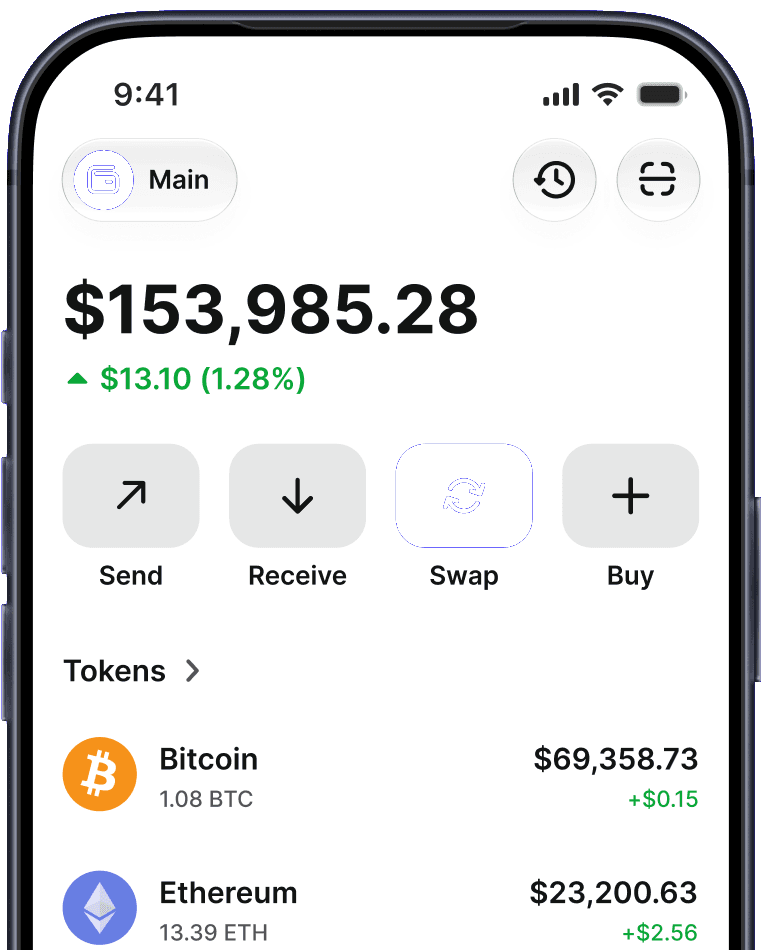
Trust Wallet lets you buy, store, send, and receive Bitcoin directly from your mobile device or browser extension. As a non-custodial wallet, Trust Wallet ensures that only you control your private keys and your BTC. You can also view your Bitcoin balance in real time, track price movements, and manage your BTC alongside 10,000+ other cryptocurrencies across 100+ blockchains.